Confirm email address
Please enter your email address and confirm the start of the simulation by clicking the link in the activation email. Please also check your spam folder if necessary.

Our free phishing test sets a special focus on the "new normal". During the COVID pandemic, the number of cyberattacks has increased dramatically, and hackers have exploited the uncertain situation to their advantage. That is why it is more important than ever to be aware of IT security related risks.
How well prepared are you for the new phishing scams?
Are you one of the few we won't catch?
Take the test

Please enter your email address and confirm the start of the simulation by clicking the link in the activation email. Please also check your spam folder if necessary.
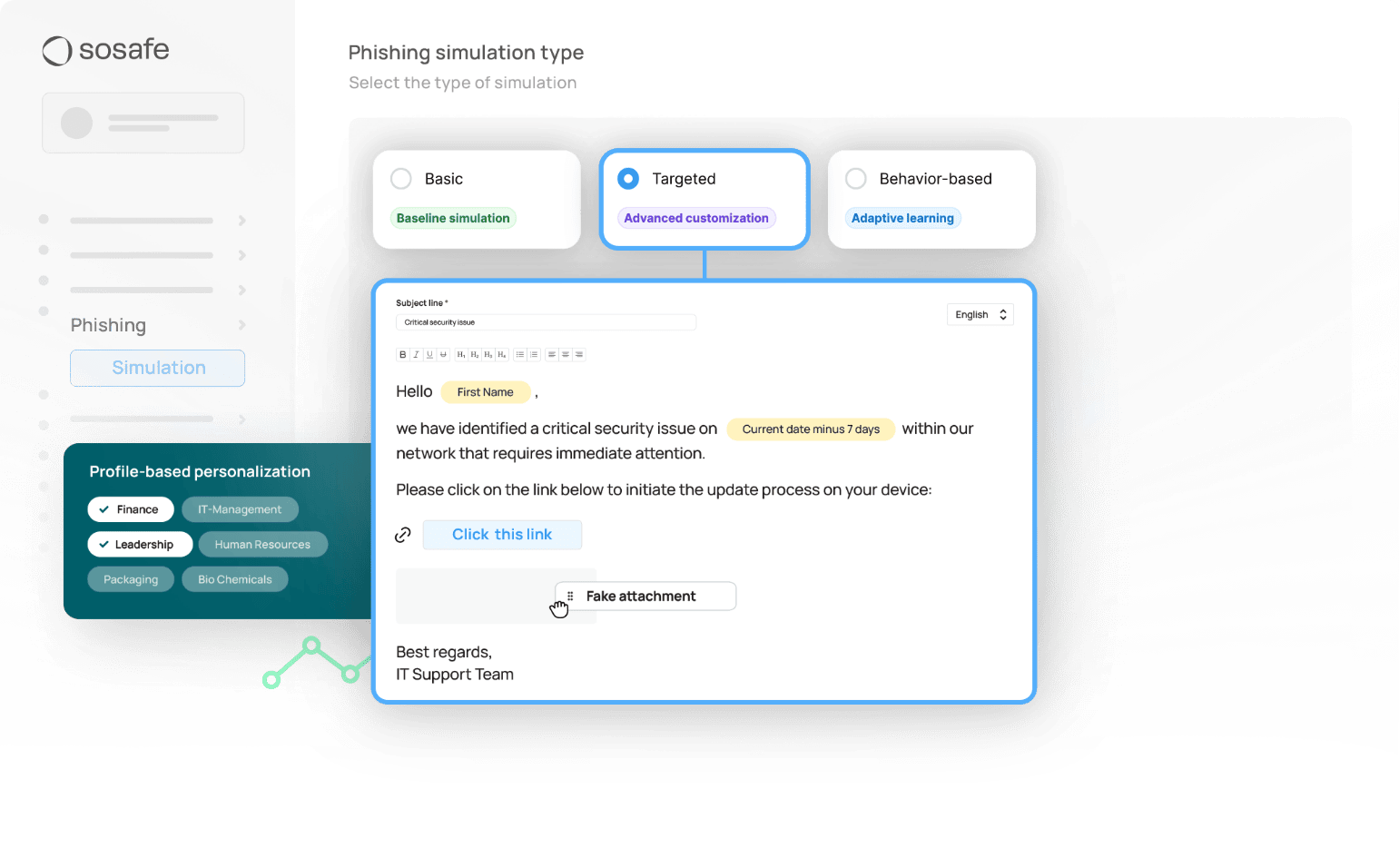
Within the next 7 days you will receive 3 completely harmless sample emails that we send out as part of our training program.
If you "fall" for one of our emails, you will be taken to a learning page that matches the email in question. At the end of the test we will send you an evaluation including links to all learning pages.
Social engineering is about manipulating, influencing or deceiving people so attackers can gain control over their computer systems. Contact is usually made by email, private messages on social networks, telephone or, more rarely, by post and direct contact. The aim of each of these methods is to gain illegal access to the user's data or that of the company they are affiliated with. Some examples of social engineering are techniques like phishing, spear phishing or the CEO trick.
Attempting to obtain sensitive information such as usernames, passwords and credit card information by impersonating a trusted institution or person. Mass emails are used to establish contact, some of which always manage to bypass the existing SPAM filters. Emails that allegedly originate from popular social networks, banks or auction websites are used to elicit sensitive information from the recipient.
"Spear phishing" – a sub-group of phishing. This involves a focused, targeted attack on an organisation with the aim of penetrating its defence mechanisms. A spear phishing attack is preceded by a more or less intensive "observation" of the target person or company so that the fraudulent contact can be enhanced through specific, personalised aspects. References to an upcoming company event, a specific colleague or the personal interests of the recipient help to significantly increase the response rate of recipients – a major risk for the company and the users affected.
In cases of CEO fraud, an email or call from a supervisor or CEO is faked in order to increase the likelihood that the employees concerned will respond to the contact. Scammers will put their targets under enormous pressure, e.g. because the alleged boss pretends to be in an emergency situation and demands quick action such as a bank transfer, the activation of a file or the release of information.
SoSafe tests, raises awareness and trains employees of companies on how to correctly handle all types of social engineering attacks.
LEARN MORE
Botfrei.de aims to reduce the number of infected computers, tablets and smartphones and to help users clean malware from their devices.
LEARN MORE
News and articles full of tips for tomorrow's IT projects can be found today at it-daily.net. This German-language platform is all about enterprise IT and IT security.
LEARN MORE
Thousands of contacts from more than 1,100 international member companies make up our industry network. Since 1995, eco has been involved in the development of the Internet in Germany and fostering new technologies.
LEARN MORE
The Cyber Security Cluster Bonn promotes the development and integration of science, research & education, business, authorities and public institutions, as well as other aspects of cyber security in the Bonn/Rhein-Sieg region.
LEARN MORE